Fanny Henriet
Faculty
,
CNRS

- Status
- Research professor
- Research domain(s)
- Environmental economics
- Thesis
- 2012, EHESS, PjSE, Banque de France
- Responsibilities
- Department director of Public economics
- Thesis supervisor
- Martin Dhaussy (since 2024), Armand Rigotti (since 2024)
- Download
- CV
- Contact
- fanny.henriet[at]univ-amu.fr
- Address
AMU - AMSE
5-9 Boulevard Maurice Bourdet, CS 50498
13205 Marseille Cedex 1
Renaud Coulomb, Fanny Henriet, Léo Reitzmann, Review of Economic Studies, Vol. 93, No. 1, pp. 404–437, 01/2026
Abstract
Not all barrels of oil are created equal: their extraction varies in both private cost and carbon intensity. Leveraging a comprehensive micro-dataset on world oil fields, alongside detailed estimates of carbon intensities and private extraction costs, this study quantifies the additional emissions and costs from having extracted the “wrong” deposits. We do so by comparing historical deposit-level supplies to counterfactuals that factor in pollution costs, while keeping annual global consumption unchanged. Between 1992 and 2018, carbon misallocation amounted to at least 11.00 gigatons of CO2-equivalent (GtCO2eq), incurring an environmental cost evaluated at $2.2 trillion (US$ 2018). This translates into a significant supply-side ecological debt for major producers of high-carbon oil. Looking forward, we estimate the gains from making deposit-level extraction socially optimal at about 9.30 GtCO2eq, valued at $1.9 trillion, along a future aggregate demand pathway coherent with the objective of net-zero emissions in 2050, and document unequal reserve stranding across oil nations.
Keywords
Misallocation, Stranded assets, Carbon mitigation, Oil
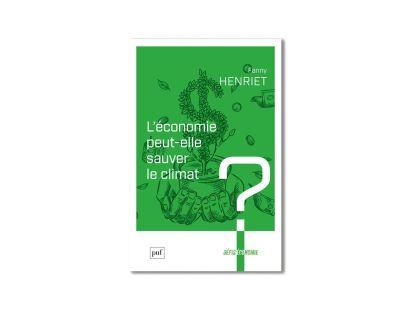
Fanny Henriet, Presse Universitaire Française, 01/2025
Abstract
L’urgence d’agir face au changement climatique n’a jamais été aussi pressante. Les coûts liés à ces perturbations sont extrêmement élevés : baisse des rendements agricoles, effets sur la santé des populations, perte de la biodiversité… Contribuant à l’amélioration de notre niveau de vie, l’économie est aussi responsable de l’augmentation incontrôlée des émissions de gaz à effet de serre. Source du problème, notre système économique est-il capable de répondre efficacement à l’urgence climatique ? Fanny Henriet invite à prendre en compte les différentes solutions possibles : décroissance, progrès technique, sobriété. Elle insiste sur la nécessité de dépasser les seules responsabilités individuelles pour engager une politique publique ambitieuse, capable de mobiliser les États comme les entreprises.
Philippe Askenazy, Thomas Breda, Fanny Henriet, Jean-François Laslier, Quentin Lippmann, Thomas Renault, Katheline Schubert, Claudia Senik, Odile Jacob, pp. 368 p., 10/2024
Renaud Coulomb, France D’agrain, Fanny Henriet
Abstract
Despite growing calls to phase it out, oil exploration persists, often justified by the natural decline of existing fields and potential efficiency gains from discoveries. This paper quantifies the global welfare and environmental impacts of restricting oil exploration. We develop a global dynamic model calibrated to a granular dataset of 14,637 proven oilfields, accounting for heterogeneity in private extraction costs, capacity constraints, life-cycle carbon intensities of oil barrels, along with exploration dynamics and basin-specific estimates of yet-to-find resources. We find that exploration restrictions are an effective second-best climate policy: in the absence of a global carbon tax, a universal ban increases global welfare by$12.5 trillion due to lower social costs of oil production and use (assuming a social cost of carbon of$200/tCO2eq). A partial ban by OECD and BRICS countries alone captures 66% of these gains. Under optimal carbon pricing, however, a global ban yields a modest $0.3 trillion welfare loss, as it precludes access to lower-social-cost deposits and prevents the easing of short-run capacity constraints.
Keywords
Stranded assets, Second-best, Ban, Carbon tax, Climate change, Oil exploration